Wednesday, April 24, 2013

Week 13: Buy Now and Bye Later


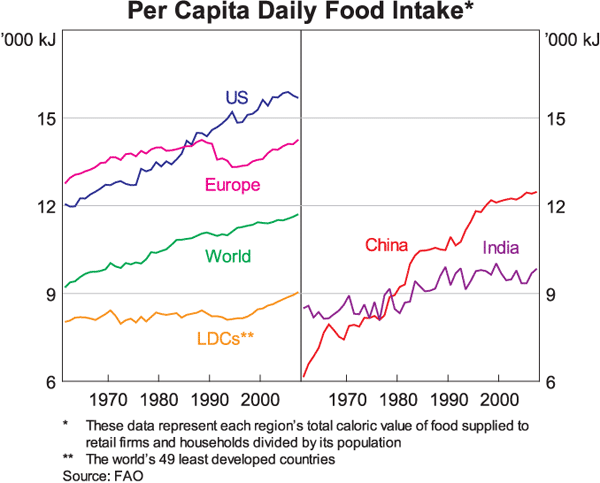
Climate change is a collective action problem augmented by transportation policy; oil and agriculture subsidies; meat-heavy diets; demand for non-seasonal varieties and cheap consumption of goods. Supply chain improvements and regulation help, but the infrastructure change needed is the societal infrastructure of ideals: the “good life” and “American dream”. The housing crash didn’t dissuade the dream for detached single family homes; will coastal flooding change our vision of good living away from massive cheap “now” consumption?

While urban political ecologies tout international equity disparages, our world economy, bound tightly with its international supply chains, depends on cheap “now” consumption. If the U.S. slows its massive consumption, or insulates consumption, economic/political chaos would ensue. Redistribution won't solve the problem. Since capitalism is the world economic system of choice, how do we solve its destructive effects without destroying the benefits?


Bigger question: what level of consumption is just—what is human habitat? 2000 sqft house vs a room, 2 automobiles vs transit, 2 global vacations a year vs regular staycations, easy / cheap air travel vs rail, etc.? The questions of how much, what dictate our spatial form as much as where. No amount of regulation or redistribution will impact the attitude of developing nations more than our example. Our collective fate lies in our severely underdeveloped societal maturity and self-restraint.
Do we want this much food?


Do we need to eat like this?

Do we want to be like this?
Should we eat like this?
Is this what we should eat?

What should we eat?
Is this our best human ecology?

How much home do we need?

How many cars do we need?


Do we need this much stuff?

How much stuff do you need?

Is this how we should consume?


Is this how we should travel?


How much vacation do you need?

Is this how we should live?

Is this how we should live?


Is this how we should work?


Wednesday, April 17, 2013

Week 12: Silver Bullets—We Need Economic Development Gun Control!


Like Al Gore with global warming, we should laude Florida not for his contribution to understanding but to awareness. Pop-sci half-science couched with attractive politics, as Markusen argues, Florida’s work repackages previous theories like human capital and agglomeration.  Florida sexy-fied economic development and economically legitimizing diversity.  Yuppies and college students may choose place first and job second, but < 30% of adults have a bachelors, ~50% have some college but no degree beyond high-school, < 30% only high-school diploma—~14% don’t have that! Education ≠ intelligence, drive or creativity, but with the loss of well-paying options without training, where are the open doors? Uneducated labor is going to be the majority of the current labor force in many areas—what do we do? Ignore, marginalize, subsidize and hope that wealthier, yuppies show up to offset tax bases? Some evidence that we're at best mismatched or worst overqualified? Look at Germany (apprentice track, university track).

Florida only focuses on large metros, but ~50% of the U.S. population lives in small cities. Markusen’s endogenous consumptive growth has merit; however, grey gold is costly, and importing tourism and exporting goods are both exogenous. Most small city cited examples (Branson, Austin, Boulder, Leavenworth, Bend) are problematic outliers. 

Wednesday, April 10, 2013

Week 11: Do Smart Cities = Better Cities?

Rio de Janeiro central command brought to you by, IBM. 
The "Smart" in Smart Cities exemplifies every issue with utopian approaches to complex issues. It’s a buzz word of packaged virtues (see also "green"), a tool of wealth, improving services for those who afford them. The utopian goals profess equity without clarity. Can you smart-sense hunger or neglect? Will eliminating more waste redirect it for good? Likely, no.

More data will not magically equate to better decisions, rather provide justification for continued poor decisions. We collect volumes of ignored data—the issue isn’t data. Data-driven decision making is pure business-speak. While potentially tempered with compassion, rarely are faces reflected in numbers on a screen. Smart cities deeply embroil the private in public. Smart city promotion passes authority without accountability to the few capable multi-nationals (IBM & Cisco) just like large-scale infrastructure / logistical projects (Halliburton).

Given smart-project’s costs—what are the social opportunity costs when most cities are struggling to meet basic services and allowing both physical (bridges, rails, levees) and social infrastructure (schools, parks, hospitals) to degrade. Will these networks increase efficiency? Likely, yes. Will that efficiency equate to better deployment of resources? Likely, no.

Because we are smart does not make us good. Our ethics rarely lead our science frequently at the cost of our humanity.

Thursday, April 4, 2013

Week 10: Citizen - to be or not to be?


These readings mull around rights, privileges, responsibilities and realities. What are the benefits of citizenship vs nationality? What formal rights of citizenship are available to those of informal status? This seems absurd in a U.S. context! Unless I’m mistaken in my understanding and value of formal citizenship rights, equal legal protection, political participation, economic opportunity, education, public services and public support are not available to undocumented (and much to documented) immigrants. These go further to somewhat define identity and much of the formal construct. Enclaves and shadow cities are only perhaps less devalued because of their complete marginalization and independence from formal structures. Yet formal citizens’ rights are suppressed and populations marginalized (public housing discussion in Hackworth).

While growing up in a poor community increases risks of poverty and those in non-poor communities benefit from better environment/resources, does the dispersing of individual poor into non-poor communities disrupt potential community beneficial activism? Are the issues with the design of public housing (other than stigma), unique to public housing?

Is the current dialog on immigration reform a snake in the grass similar to HOPE VI? Is it sidestepping a conflict or tripping a potential movement? Is this a political form of the spatial/temporal fix?

Wednesday, March 27, 2013

Week 9: Road Trip for Cities?


Harvey interjects time into urban analysis which creates a beautifully organic ebb-and-flow between many polarized disputations. However, most are framed in progressive process terms (shrinking cities?). His arguments around natural vs built environments are better framed in the aforementioned temporal-spatial flux, uprooting any established confine (zoning, lot, building, park, edge-boundary-limit) as a temporary part of the narrative and equally diffusing if/then (when) logic from our decision framework; this ignores the built environment largely supplants the natural (sometimes with near-permanent consequence [nuclear power, fracking, mining, etc.])—just look where that wheat field use to be and where the Walmart parking lot begins!  When examined with process vs. thing, the parking lot will someday revert to a wheat field or forest…the urban fabric as a journey not destination. How do we integrate into comprehensive planning in dynamic environments?

Community: relational structures evolve naturally; obviously physical place doesn’t create community (both exist without the other), but it does facilitate it (density, public space, site positioning, transportation structures, 3rd spaces). Isn’t all community exclusionary? Does social capital exist outside community?  Perhaps public is falling to private (both monolithic and inaccessible) but free speech is not tied to public physical space—INTERNET! 

Thursday, March 14, 2013

Week 8: Growth ≠ Good?


I question our relationship with growth, decline and ‘stagnation’. Does growth mean prosperity (not considering social justice) and decline poverty? Sustainability may coalesce from ‘stagnation’, where impacts are neutral. Planning traditionally channels growth and here decline—why not refocus on quality (Europe)? Is stability (equilibrium) better than growth? Economically, I understand motivations for population growth and agglomeration economics, but can’t small be quality? Growth compensates for increase in value. Mallach’s equity critique of policies which create higher-end jobs is ridiculous—pay follows value (absolute vs relative). Manufacturing’s decline due to spatial fix was regrettable for uneducated labor, but our national value is not in cheap mass labor; its innovation. Rather than the myopic stance on pure market redistribution, channel equity planning and Krumholz’s “providing “a wider range of choice for those…residents who have few” (Making Equity Planning Work 1990).

Equity is internal conflicted when presented with shrinking neighborhoods: the choice of those who leave vs those who stay (poorer schools, services, infrastructure). As noted, those who stay may reduce options for other communities. Is pure redistribution the only mitigation or can we not have our cake and eat it too? Must we destroy some communities for the good of others? 


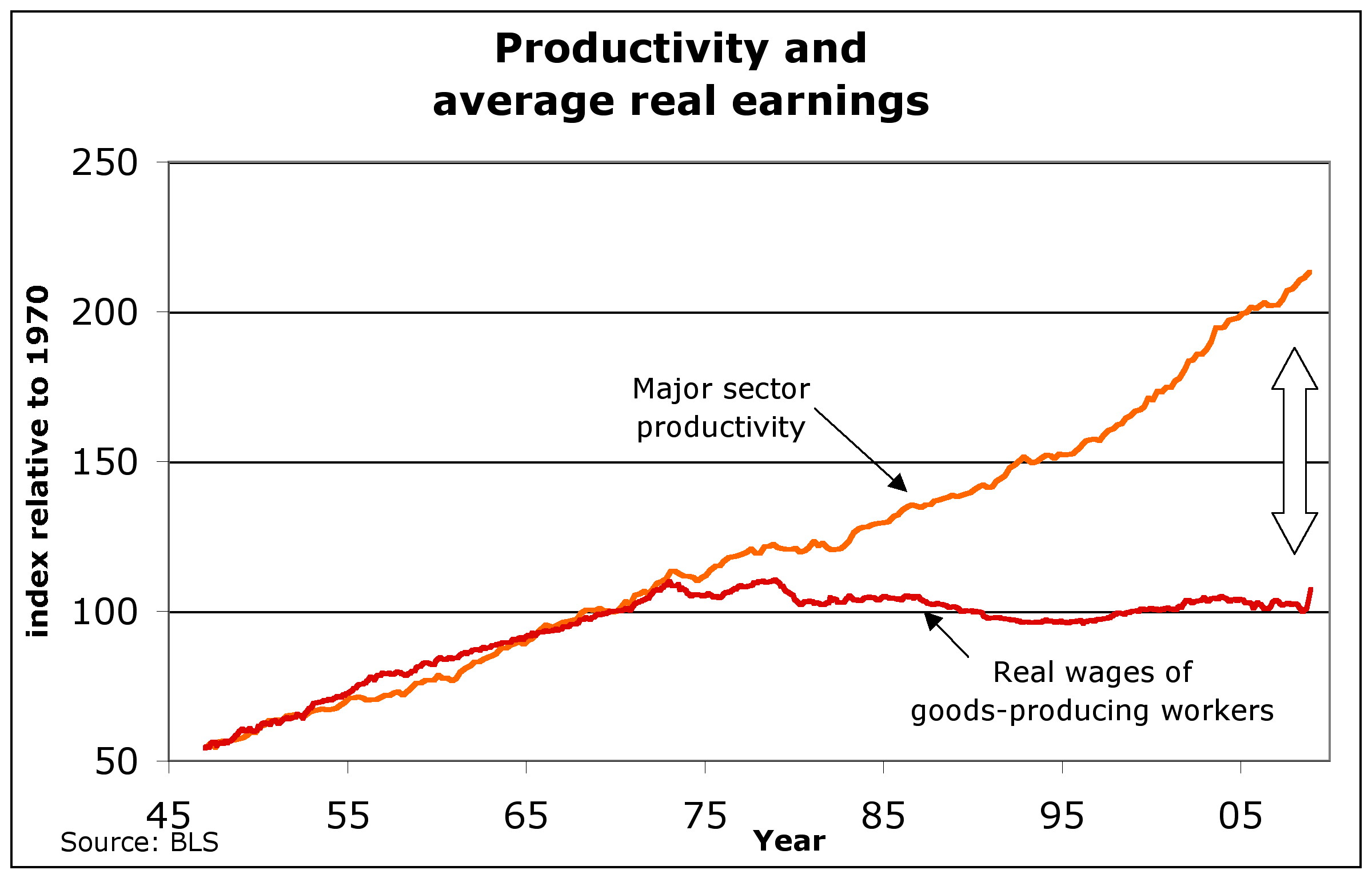
This chart is what should disturb -- when innovation doesn't = wage. Or is innovation just another type of fix?

Thursday, March 7, 2013

Week 7: Life in the Big (Theoretical) City

Given the problematic criteria in McDonald (Sassen), (assuming some unknown and unambiguous criteria threshold) what cities are left? Descriptive, yes; useful…?
  1. Globalization & Spatial Concentration: (Developed nations) Are there any spatial concentrations where globalization hasn’t had influence? Are there purely regional cities?
  2. Rising Service Economy: A general economic trend in developed nations.
  3. Agglomeration Economies: Scale?
  4. Exiting manufacturing headquarters: A general economic trend.
  5. World City Networks: Legacy infrastructure? Airline hubs? (Denver, SLC, Detroit) Internet?
  6. Local Disconnection: Is NYC more dependent on non-domestic cities? Economic cycles of national demand? Are there any really independent cities? Contrary to local disconnection, should we examine regional agglomerations (R. Florida’s image below) as centers for global production?
  7. Socioeconomic and Spatial Polarization: A general macro-economic trend.
  8. Informalization: Informal economies yes; however, where are the informal urban settlements in the developed world (homeless, couch surfers, squatters)? These aren’t close to the complexity of informal settlements like favelas and shadow cities of the global south. Rural is HEAVILY based on the informal economy. What legitimizes a “formal” economy? Is most of the U.S. agriculture a “formal” economy with its shadow workers?

Additionally, is history more powerful than narrative in global cities (Shenzhen vs London vs Sao Paulo)?

Thursday, February 28, 2013

Week 6: A Balanced System?


It’s overstated that borders are irrelevant; referencing Scott: cities are signing treaties (Kyoto) and forming embassies in other nations. In our system, cities function at the mercy of states, reinforced by tax code. Should cities retain their taxes--what affects would that have on suburbanization, resource use and poverty (devastating federal power & rural areas)? Does multinational capital flow weaken national borders? Don’t we require state regulations against abuse of those powers? Multinational blocs appear solely economic and weak: the EU’s recent existential battle based on nation-state economics illustrates. The United States were a confederation of independent nation-states under a historically weak central government. That changed, and city-regions are powerful economic and political players (New York, LA, Chicago foremost). Our economies are independent from others, however, highly interdependent. However, interdependence isn’t indivisibility. Strong trade linkages can’t ignore intraregional supply and demand, nor the political realities of nation-states. Notwithstanding agglomeration, the ongoing shifts in diffused producers and wiki-sizing have yet to be fully realized. Recently Yahoo forced all remote employees back to their central offices--these are parallel debates.  Based on their actions, few business leaders and city managers understand the functions/benefits of agglomeration. I’m not sure I do. 

Thursday, February 21, 2013

Week 5: Pop Goes the Weasel


Interestingly, these articles spoke of cycles of creative destruction (bubbles). Its relevance is plainly seen to all who were aware during the past five years. However, I join with Fainstein in decrying the lack of an effective progressive strategy for generating growth in declining areas. Additionally, I’m growing tired of binary ideological villainizations and clearly non-neutral analysis. Harvey’s piece was thought provoking, but wholly self-aggrandizing (he only cites himself—is he the only thought leader on the subject in the last 40 years!). Yes, trickle down isn’t equitable, the realities of rich/poor dichotomies are obscene, and wage/inflation/productivity divergence is troubling—what is a pragmatic solution! The cycles of accumulation and fixes are a fascinating explanation of the inherent tragedy of capitalism, and the paradox of the spatial fix is fascinating. The blight article reminded me again of the troubling assurance of our solutions—were we any less sure of ourselves then as we are now? Moreover, by fully turning away from that thinking, were we altogether wrong?

Thursday, February 14, 2013

Week 4: Sticky Agglomerations


Quigley: Are agglomerations about size, density or both? Do agglomerations benefit all city areas? No. Why? Negative agglomerations? Neighborhood factor? What scale of agglomeration matters? Extremely high density, nodal, low? Benefits are not just from size (declining large cities); however, how can declining cities NOT capture more value from large agglomerations? The research, even considering human capital, is based on production; what about the economic shift (broad production base to highly agglomerated, high-end production; broad consumption-driven, service-based economy)? Points of consumption agglomerate (particularly as transportation costs rise); however, what about the internet as a different agglomerating force (placeless consumption / production).

What about agglomerations for humans as social beings? Can social capital be an agglomerating force for residential or is it destructive?

Equilibrium vs. increasing returns to scale. Optimal city size is unknown, but there is a pattern for size (Zipf's Law). Does the city follow living systems with finite lifespan vs. mass: WATCH THIS!

Enhanced local amenities / benefits of agglomeration and maintaining a flexible workforce should reduce wages (not observed). Can agglomeration attract too many? Why no tragedy of the commons?

Human capital = education = universities  economic growth. Growth near universities favors services from massively subsidized consumption. 


Thursday, February 7, 2013

Week 3: Where is Here


Engels writing, while anti-city, introduces an activist journalism that raises questions of the planner’s role: are we advocates or observers? Mixed with the individual ethnographical focused Chicago school, the city is individuals—but are we not required (comprehensive plan) to agglomerate the whole? Can we plan a massive individual endeavor?

These passages are a disturbing reminder of how they lived, but also how billions live today. The squalor of the majority hasn’t diminished; have our responsibilities? The conscious rancor bites at our professions legitimacy and calls for response within each sphere of influence.  There are quiet billions without essentials. Engel’s power (and those aligned in personally uncovering society’s unacknowledged externality) is not only in raising human concern and attention, but demonstrating its proximity. Additionally, what role have we played through pursuit of utopian or just ideal? 

Engel also paints shadows of environmental justice, illustrated in the TIMBYism (this-is-my-backyard) of these neighborhoods. The areas described however, would likely (if not eroded, redeveloped or renewed) be most popular today.  These places with the highest market demand stand on the backs of deprivation. Oddly enough, they are areas un-creatable given our evolved development controls. Will suburbs someday be hip?

Massy—why?