Wednesday, March 27, 2013

Week 9: Road Trip for Cities?


Harvey interjects time into urban analysis which creates a beautifully organic ebb-and-flow between many polarized disputations. However, most are framed in progressive process terms (shrinking cities?). His arguments around natural vs built environments are better framed in the aforementioned temporal-spatial flux, uprooting any established confine (zoning, lot, building, park, edge-boundary-limit) as a temporary part of the narrative and equally diffusing if/then (when) logic from our decision framework; this ignores the built environment largely supplants the natural (sometimes with near-permanent consequence [nuclear power, fracking, mining, etc.])—just look where that wheat field use to be and where the Walmart parking lot begins!  When examined with process vs. thing, the parking lot will someday revert to a wheat field or forest…the urban fabric as a journey not destination. How do we integrate into comprehensive planning in dynamic environments?

Community: relational structures evolve naturally; obviously physical place doesn’t create community (both exist without the other), but it does facilitate it (density, public space, site positioning, transportation structures, 3rd spaces). Isn’t all community exclusionary? Does social capital exist outside community?  Perhaps public is falling to private (both monolithic and inaccessible) but free speech is not tied to public physical space—INTERNET! 

Thursday, March 14, 2013

Week 8: Growth ≠ Good?


I question our relationship with growth, decline and ‘stagnation’. Does growth mean prosperity (not considering social justice) and decline poverty? Sustainability may coalesce from ‘stagnation’, where impacts are neutral. Planning traditionally channels growth and here decline—why not refocus on quality (Europe)? Is stability (equilibrium) better than growth? Economically, I understand motivations for population growth and agglomeration economics, but can’t small be quality? Growth compensates for increase in value. Mallach’s equity critique of policies which create higher-end jobs is ridiculous—pay follows value (absolute vs relative). Manufacturing’s decline due to spatial fix was regrettable for uneducated labor, but our national value is not in cheap mass labor; its innovation. Rather than the myopic stance on pure market redistribution, channel equity planning and Krumholz’s “providing “a wider range of choice for those…residents who have few” (Making Equity Planning Work 1990).

Equity is internal conflicted when presented with shrinking neighborhoods: the choice of those who leave vs those who stay (poorer schools, services, infrastructure). As noted, those who stay may reduce options for other communities. Is pure redistribution the only mitigation or can we not have our cake and eat it too? Must we destroy some communities for the good of others? 


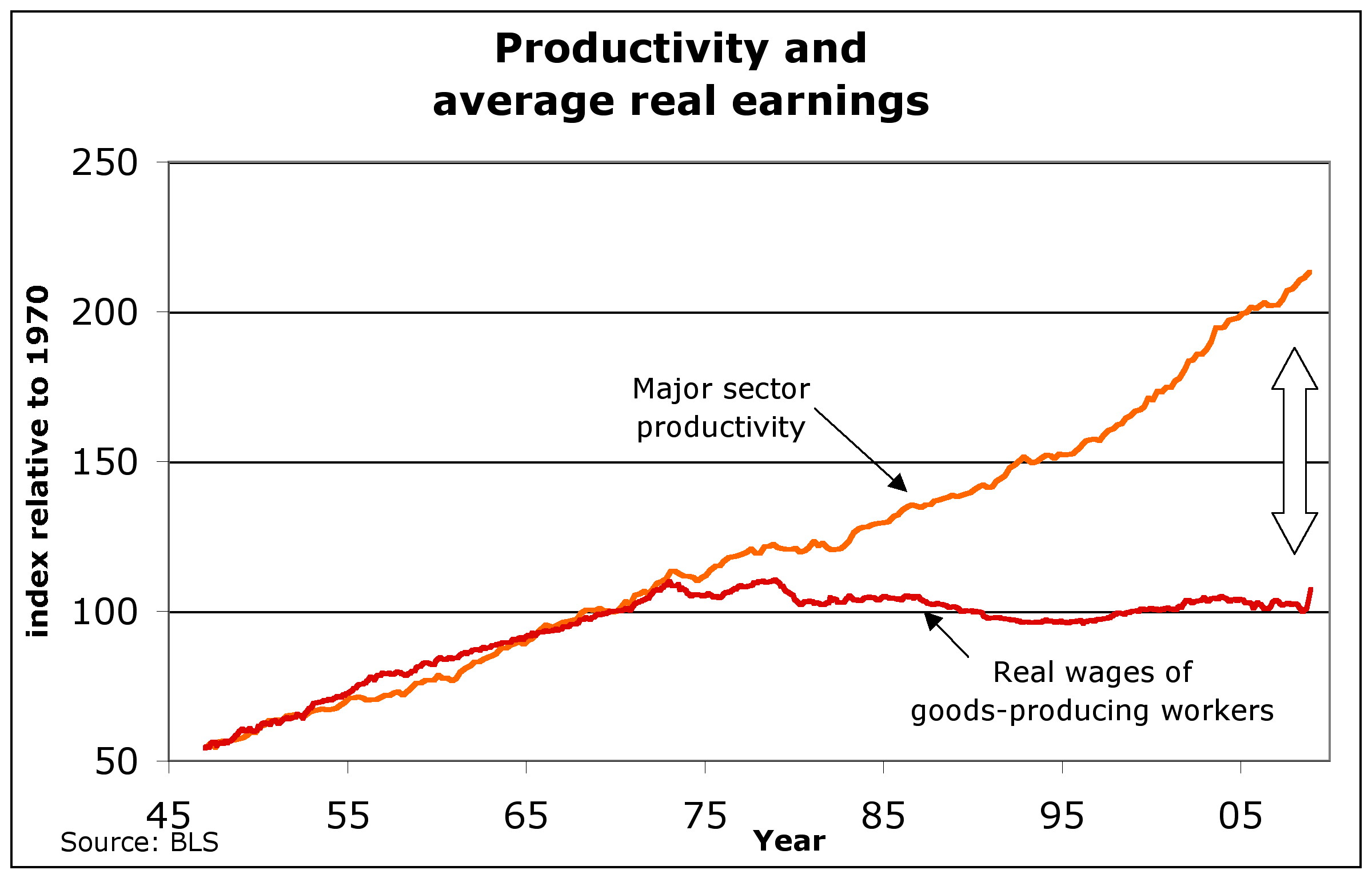
This chart is what should disturb -- when innovation doesn't = wage. Or is innovation just another type of fix?

Thursday, March 7, 2013

Week 7: Life in the Big (Theoretical) City

Given the problematic criteria in McDonald (Sassen), (assuming some unknown and unambiguous criteria threshold) what cities are left? Descriptive, yes; useful…?
  1. Globalization & Spatial Concentration: (Developed nations) Are there any spatial concentrations where globalization hasn’t had influence? Are there purely regional cities?
  2. Rising Service Economy: A general economic trend in developed nations.
  3. Agglomeration Economies: Scale?
  4. Exiting manufacturing headquarters: A general economic trend.
  5. World City Networks: Legacy infrastructure? Airline hubs? (Denver, SLC, Detroit) Internet?
  6. Local Disconnection: Is NYC more dependent on non-domestic cities? Economic cycles of national demand? Are there any really independent cities? Contrary to local disconnection, should we examine regional agglomerations (R. Florida’s image below) as centers for global production?
  7. Socioeconomic and Spatial Polarization: A general macro-economic trend.
  8. Informalization: Informal economies yes; however, where are the informal urban settlements in the developed world (homeless, couch surfers, squatters)? These aren’t close to the complexity of informal settlements like favelas and shadow cities of the global south. Rural is HEAVILY based on the informal economy. What legitimizes a “formal” economy? Is most of the U.S. agriculture a “formal” economy with its shadow workers?

Additionally, is history more powerful than narrative in global cities (Shenzhen vs London vs Sao Paulo)?